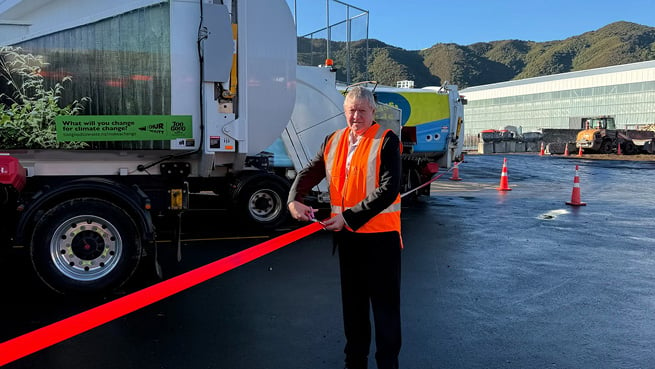
Chris Wells, who managed the landfill from day one, acknowledged the strength of those early concerns.
“There was a lot of concern at the beginning, particularly from local residents,” Wells said in the original coverage.
Among the most vocal objectors were residents living near the proposed site, including community leaders such as Colin Kendall, who also chaired the local school board. Fears centred on the risk of contaminated waterways, the visual impact of the landfill, and the stigma associated with living near a “rubbish tip.”
In response, WM New Zealand, then Waste Management, engaged directly with the community, presenting international examples to demonstrate how modern landfill operations could function.
At the time, some community members said their experience of the site had been different from what they had initially feared.
“They’ve lived up to all those expectations — and if anything, exceeded them,” Kendall said.
The Redvale facility represented a turning point in landfill design in New Zealand. Unlike the unmanaged dumps of earlier decades, modern landfills were built on engineered systems designed to protect land, water and air. At Redvale, this included a thick natural geological base reinforced with engineered liners, as well as systems to capture landfill gas and treat leachate.
Daily operations were also designed to minimise disruption. Waste was covered at the end of each day, dust and odour were managed, and windblown material was contained, a stark contrast to older landfill practices.
Oversight from a Community Liaison Committee provided a forum for transparency, with access to operational data, complaints and engineering reports.
“We’re very satisfied that if anything goes wrong, it’s attended to very quickly — and very little does,” Kendall said.
Over time, environmental controls, monitoring and communication processes became more established. While some early concerns eased, community discussion about the landfill and its impacts continued.
A Legacy That Shaped Modern Environmental Practice
More than three decades on, the principles that underpinned Redvale’s development continue to influence how landfill operations are managed across New Zealand, with significantly expanded scope and sophistication.
Today, environmental management is framed not just as compliance, but as an integrated system grounded in Te Taiao — a holistic view of the natural environment.
Modern operations are supported by comprehensive governance structures, including dedicated environmental and landfill leadership groups that set and monitor performance standards. These are reinforced by proactive consent management, ongoing staff training, and rigorous monitoring and reporting systems designed to support continuous improvement.
The engineered safeguards first highlighted in the 1990s have also evolved. Advanced lining systems, leachate treatment technologies, and gas capture infrastructure now form part of a broader approach to managing waste responsibly and protecting surrounding ecosystems.
A Broader Approach to Environmental Stewardship
Where early discussions focused on minimising harm, today’s approach reflects a broader responsibility to protect surrounding land, water and ecosystems.
This includes not only managing current landfill operations, but also addressing historical environmental challenges. Across Aotearoa, hundreds of legacy dump sites continue to pose risks, particularly as climate change increases the likelihood of extreme weather events.
Projects such as the recent remediation of coastal landfill sites in the South Island demonstrate how the industry is working to resolve these historic issues. Efforts have included relocating vulnerable wildlife, safely containing decades-old waste, and restoring stability to environmentally sensitive areas.
These initiatives reflect how expectations of landfill management have changed over time, with greater focus on environmental restoration alongside containment.
Protecting Air and Reducing Emissions
Landfill gas, once seen as a byproduct to be managed, is now central to emissions reduction strategies.
Modern landfill systems are designed to capture the majority of methane produced by decomposing waste, helping reduce emissions and, at some sites, generate electricity. Advanced technologies, such as drone-based methane monitoring, now allow operators to detect and respond to emissions with precision, identifying even small hotspots in real time.
Sophisticated modelling, aligned with international climate guidance, enables more accurate tracking of emissions over time, while independent validation supports transparency and credibility.
Innovations such as closed-loop systems, where landfill gas is used to treat leachate, further demonstrate how waste streams can be repurposed to improve environmental outcomes.
Safeguarding Water and Ecosystems
Water protection, a major concern in the original Redvale debate, remains a central focus, but with far more advanced scientific backing.
Modern landfill operations apply detailed baseline studies, strict monitoring thresholds, and internationally recognised water quality standards to help protect surrounding waterways. Treatment systems, including aeration ponds and evaporation technologies, are now standard across sites.
Beyond compliance, ecological monitoring, such as sediment sampling and macroinvertebrate surveys, provides insight into the health of surrounding ecosystems, allowing early detection of environmental change.
Looking Back
Looking back, the 1990s news coverage of Redvale captured a moment of uncertainty, a community weighing the risks of a new kind of infrastructure.
Today, that same site stands as an early example of how landfill design and environmental management have evolved. Many of the concerns raised at the time helped shape the systems, monitoring and expectations that exist today.
As Wells reflected at the time: “I can understand why people are concerned about landfills… but I’m proud of what we’ve achieved.”
That story continues to evolve, alongside changing expectations around how waste is managed and how the environment is protected for future generations.